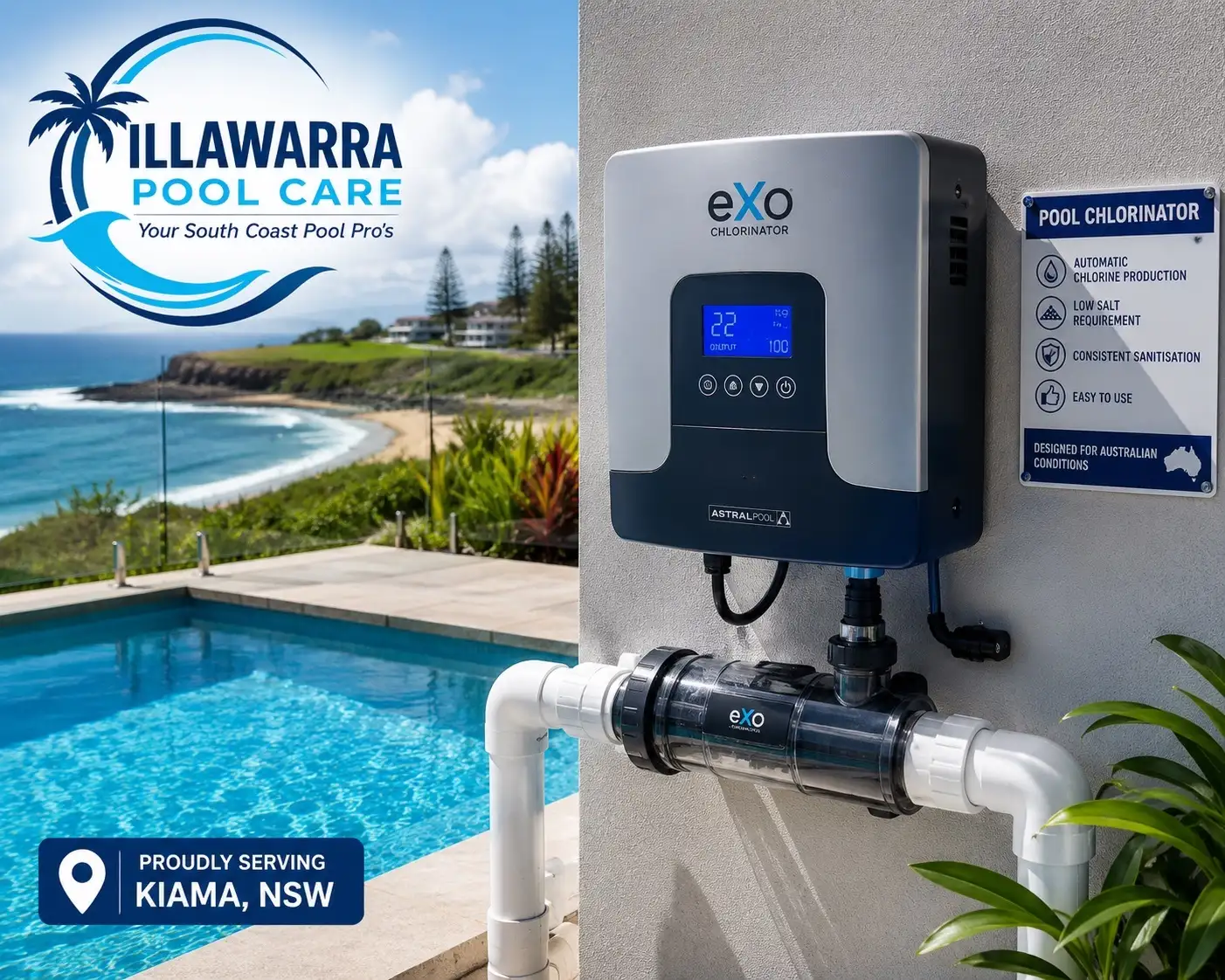
A salt chlorinator is one of the most important pieces of equipment in your swimming pool. It automatically converts dissolved salt into chlorine, keeping your pool sanitised, healthy and ready for swimming. When the chlorinator begins to fail, chlorine production decreases, water quality deteriorates and algae can develop surprisingly quickly.
Many homeowners don’t realise there is a problem until the water becomes cloudy or green. Recognising the warning signs early can help prevent expensive repairs, avoid unnecessary chemical costs and protect your pool equipment.
At Illawarra Pool Cleaning, we regularly diagnose and replace faulty chlorinators and worn salt cells throughout Wollongong, Shellharbour, Kiama and the South Coast. This guide explains the most common signs that your chlorinator may need replacing.
What Does a Pool Chlorinator Do?
A salt chlorinator uses electrolysis to convert dissolved salt into chlorine.
The chlorine produced by the chlorinator:
- Kills bacteria
- Prevents algae growth
- Sanitises pool water
- Keeps swimmers safe
- Reduces manual chlorine dosing
Without a properly functioning chlorinator, maintaining healthy pool water becomes much more difficult.
1. Your Chlorinator Is Not Producing Chlorine
The most obvious warning sign is low or zero chlorine production.
You may notice:
- Low chlorine test results
- Cloudy water
- Algae beginning to grow
- Increasing chemical use
- Water that no longer feels fresh
If your salt level and water balance are correct but chlorine remains low, the chlorinator or salt cell may require replacement.
2. Your Pool Keeps Turning Green
One of the first signs of chlorinator failure is recurring algae.
If your pool repeatedly turns green despite:
- Correct chemical additions
- Filter cleaning
- Pump operation
- Regular servicing
the chlorinator may no longer be producing enough chlorine to keep algae under control.
3. Low Salt Warning Despite Correct Salt Levels
Many modern chlorinators display “Low Salt” or “Check Salt” messages.
If professional water testing confirms the salt level is correct but the warning remains, possible causes include:
- Worn salt cell
- Faulty salt sensor
- Internal electronics fault
- Scaling on the cell plates
This is one of the most common reasons homeowners contact us for a chlorinator inspection.
4. The Salt Cell Has Reached the End of Its Life
The salt cell is the component that produces chlorine.
Although the control box may continue operating, the cell itself gradually wears over time.
Most quality salt cells last around 4 to 7 years, depending on:
- Pool size
- Pump operating hours
- Water balance
- Cleaning frequency
- Cell quality
Replacing only the salt cell is often possible if the control unit remains in good condition.
5. Frequent Error Messages
Modern chlorinators contain electronic diagnostics.
Repeated warnings such as:
- Low Salt
- No Flow
- Cell Fault
- Output Error
- Check Cell
may indicate that the system requires professional inspection.
Some faults are minor, while others signal that replacement is becoming the more economical option.
6. White Scale on the Salt Cell
Calcium scale can build up on the cell plates over time.
A light build-up can usually be cleaned safely.
However, heavy scaling may indicate:
- Poor water balance
- High calcium hardness
- Ageing cell plates
- Reduced chlorine production
Regular servicing helps minimise scale and extend salt cell life.
7. The Chlorinator Is More Than 8–10 Years Old
Most chlorinator control units have a service life of around 8 to 12 years.
As equipment ages:
- Electronics deteriorate
- Efficiency declines
- Repairs become more frequent
- Spare parts become harder to source
If your chlorinator is approaching this age and showing signs of failure, replacement is often the most reliable long-term solution.
8. Increasing Chemical Costs
Many homeowners notice they’re manually adding chlorine more often.
This usually indicates:
- Reduced chlorine production
- Salt cell wear
- Incorrect output
- Electrical faults
A properly functioning chlorinator should maintain chlorine levels with only routine water balancing.
Salt Cell Replacement or Full Chlorinator Replacement?
Not every chlorinator problem requires a complete replacement.
A salt cell replacement may be suitable when:
- The control unit operates normally
- Only chlorine production has declined
- The salt cell has reached the end of its life
- The chlorinator is relatively new
A complete chlorinator replacement is often recommended when:
- The control unit has failed
- Multiple electrical faults exist
- Spare parts are unavailable
- Repair costs approach replacement costs
- The system is outdated and inefficient
We’ll always inspect your equipment first and recommend the most practical and cost-effective solution.
Benefits of Upgrading to a New Chlorinator
Modern chlorinators offer significant improvements over older systems.
Benefits include:
- More reliable chlorine production
- Improved self-cleaning technology
- Better energy efficiency
- Digital controls
- Easier programming
- Longer salt cell life
- Smart diagnostics
- Lower maintenance
Upgrading often improves water quality while reducing long-term operating costs.
Professional Chlorinator Replacement Across the Illawarra
Illawarra Pool Cleaning supplies and installs quality chlorination systems throughout:
- Wollongong
- North Wollongong
- Fairy Meadow
- Corrimal
- Bulli
- Woonona
- Thirroul
- Shellharbour
- Shell Cove
- Albion Park
- Oak Flats
- Kiama
- Kiama Downs
- Minnamurra
- Jamberoo
- Gerringong
- Gerroa
- Berry
- Shoalhaven Heads
We inspect your existing equipment, test your water chemistry and recommend the most suitable replacement system for your pool.
Why Choose Illawarra Pool Cleaning?
Customers trust us because we provide:
- Honest equipment advice
- Professional chlorinator inspections
- Salt cell replacement
- Quality chlorination systems
- Experienced technicians
- Reliable workmanship
- Competitive pricing
- Friendly local service
- Free quotations
We focus on solving the problem correctly rather than replacing equipment unnecessarily.
Frequently Asked Questions
How long does a salt cell last?
Most quality salt cells last between 4 and 7 years, depending on water balance, operating hours and maintenance.
Why is my chlorinator not producing chlorine?
Common causes include a worn salt cell, incorrect salt levels, poor water balance, electrical faults or a failed control unit.
Can I replace just the salt cell?
Yes. If the control unit is still working correctly, replacing the salt cell is often the most economical solution.
Why does my chlorinator keep saying “Low Salt”?
This can be caused by genuinely low salt levels, a worn salt cell, calcium scaling or a faulty sensor. Professional testing can identify the exact cause.
Should I repair or replace my chlorinator?
If the unit is older, has repeated faults or requires costly repairs, replacement is often the better long-term investment.
Book a Pool Chlorinator Inspection Today
If your chlorinator is displaying error messages, struggling to produce chlorine or your pool keeps turning green, don’t wait until the problem becomes worse.
At Illawarra Pool Cleaning, we provide professional chlorinator inspections, salt cell replacement and complete chlorinator upgrades throughout Wollongong, Shellharbour, Kiama and the South Coast. We’ll assess your equipment, explain your options and recommend the best solution to keep your pool healthy and operating efficiently.
Call 0410 981 271 today for a free quote on professional pool chlorinator replacement.